🧠
40nm Premium RSX Swap / Replacement
Our preferred Frankenstein RSX: factory bare-die 40nm silicon from select Super Slim MSX/MPX donors with a completely renewed die-level thermal interface.
View service details → iKon Technical SolutionsPS3 Hardware Restoration
PS3 Frankenstein Repair Service
Professional PS3 CELL delid and thermal-interface restoration. We intentionally avoid routine 40nm RSX delidding and prefer factory bare-die 40nm RSX hardware to reduce mechanical stress and package damage risk.
This is physical electronics repair only. This service does not include custom firmware, jailbreaks, modchips, copied games, downloaded games, piracy tools, firmware or system software modification, copyright bypassing, or instructions for accessing paid content.
Service Overview
Delidding removes the integrated heat spreader (IHS) from the top of a processor so the thermal material hidden underneath it can be replaced. On aging FAT PlayStation 3 systems, this internal thermal interface can become dry, hardened or ineffective after many years of heat cycling.
Replacing only the thermal paste visible on top of the heat spreader does not address this hidden interface. If heat transfer between the silicon die and the IHS has degraded, temperatures can remain unnecessarily high even after a normal cleaning and external thermal-paste service.
For this reason, CELL delidding is offered as part of our premium thermal restoration process when appropriate.
The CELL processor is the primary focus of this service. When the internal thermal interface has deteriorated, carefully removing the CELL heat spreader allows us to clean the original material and restore the die-to-IHS thermal interface.
The objective is not simply to produce a lower temperature number. Proper thermal transfer allows heat generated by the CELL die to move efficiently into the heat spreader, heatsink and cooling system instead of remaining concentrated at the silicon.
We do not routinely delid 40nm Slim RSX processors.
This is intentional.
A 40nm RSX can physically be delidded, but the fact that something can be done does not automatically mean it is the best engineering choice for a long-term restoration.
The RSX package is a multilayer semiconductor assembly consisting of the silicon die, package substrate, underfill, memory devices and thousands of BGA interconnections beneath the package. Removing the IHS requires mechanical force to be applied to an assembly that was never designed to be repeatedly separated after manufacture.
Even when the procedure appears successful externally, unnecessary flexing, twisting or lifting of the package can place stress into the substrate, underfill structure, solder interconnects and surrounding memory devices.
The 40nm RSX packages used in Slim PlayStation 3 systems are particularly valuable as Frankenstein donor hardware. Our position is that intentionally adding mechanical stress to a known-good 40nm RSX simply to remove its heat spreader is an unnecessary risk when a better factory solution exists.
Our inspection and X-ray work has reinforced this position. Semiconductor-package damage does not always present as an obvious cracked die or visibly broken component. Mechanical stress can produce subtle substrate deformation, internal interconnect damage or micro-fracturing that may not be visible during a normal microscope inspection.
A console successfully booting immediately after a delid also does not prove that no package stress was introduced.
For that reason, we will not routinely remove a 40nm RSX heat spreader merely to achieve direct-die cooling.
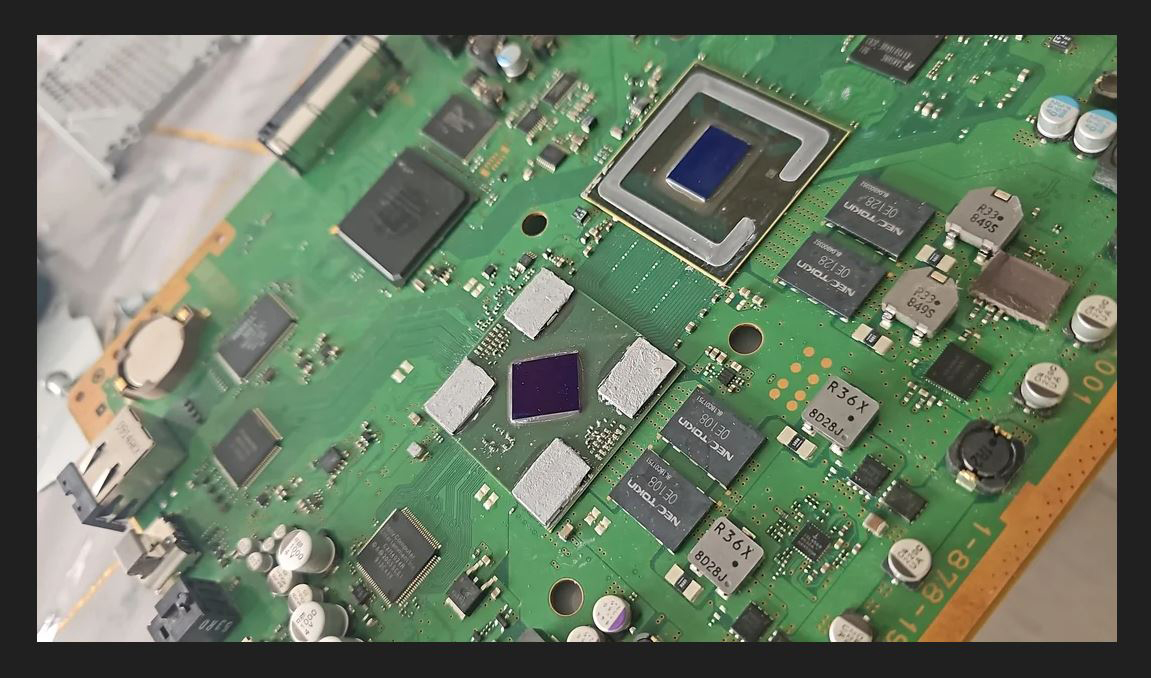
For customers selecting our Premium 40nm Frankenstein configuration, our preferred solution is a factory bare-die 40nm RSX sourced from compatible early Super Slim PlayStation 3 hardware.
These RSX packages were manufactured by Sony's supply chain to operate without the traditional RSX integrated heat spreader. The silicon die is already exposed from the factory.
This gives us the thermal advantage people are attempting to achieve by delidding a Slim RSX without requiring us to mechanically remove an IHS from a completed semiconductor package.
This is why our Premium 40nm RSX service uses factory bare-die hardware whenever possible. We would rather begin with a processor engineered to operate bare than mechanically convert an IHS-equipped 40nm RSX into one.
There is a tendency in the repair community to treat delidding as though removing every available heat spreader automatically produces a better console. We do not take that approach.
Every thermal modification has to be evaluated against both its potential benefit and the mechanical risk required to achieve it.
If an excellent thermal result can be achieved without disturbing a semiconductor package, preserving the original package structure is generally the preferable option.
Older RSX generations and specific restoration circumstances are evaluated individually. Package construction, chip condition, intended use and the rest of the repair determine whether RSX delidding provides enough benefit to justify the procedure.
RSX delidding is therefore not automatically included simply because a console is already disassembled.
A 40nm RSX delid is considered only when there is a legitimate technical reason that makes retaining the existing processor preferable and no better practical alternative is available.
If we determine that a 40nm RSX delid is justified, it is treated as a separate high-risk procedure and carries an additional $60 service charge.
Where appropriate, a chemical-assisted process may be used to weaken the IHS bonding material before separation in an effort to reduce the mechanical force required. This can reduce risk, but it cannot eliminate it.
We do not perform a 40nm RSX delid simply because a customer requests direct-die cooling when a safer factory bare-die solution is available.
The complete PS3 thermal path begins at the silicon itself:
A restriction anywhere in this path increases thermal resistance. Restoring the internal CELL interface can therefore be important even when the heatsinks, fan and external thermal paste are already in excellent condition.
Delidding is only one part of thermal restoration. Our premium Frankenstein builds address the system as a complete thermal and electrical platform rather than relying on one modification.
We do not delid a chip simply because we know how.
The objective of a premium restoration is to improve reliability while introducing the least additional risk possible. CELL delidding can provide a meaningful thermal benefit and is performed where appropriate. Routine 40nm RSX delidding introduces a package-level risk that we believe is unnecessary when factory bare-die 40nm RSX hardware is available.
For us, the best repair is not the modification that looks the most extreme. It is the configuration that achieves the required thermal performance while preserving as much semiconductor integrity as possible.
Premium Packages Customized to your budget.
Related Service Options
Most premium restorations combine multiple hardware services depending
on the condition of the console.