🧠
40nm Premium RSX Swap / Replacement
Our preferred Frankenstein RSX: factory bare-die 40nm silicon from select Super Slim MSX/MPX donors with a completely renewed die-level thermal interface.
View service details → iKon Technical SolutionsPS3 Hardware Restoration
PS3 Frankenstein Repair Service
Professional PS3 CELL and RSX VDDC core undervolting through hardware-level SYSCON VID configuration. Separate from the required Frankenstein VDDR and resistor modifications.
This is physical electronics repair only. This service does not include custom firmware, jailbreaks, modchips, copied games, downloaded games, piracy tools, firmware or system software modification, copyright bypassing, or instructions for accessing paid content.
Service Overview
Our CELL / RSX Undervolting service is an optional VDDC/Vcore optimization performed after the console's required hardware configuration has been completed.
This is completely separate from the required Frankenstein RSX Voltage / Resistor Mod.
The Frankenstein voltage modification establishes the correct VDDR configuration for a replacement 65nm or 40nm RSX. Undervolting instead changes the operating voltage of the processor cores themselves.
| Modification | What It Changes | Purpose | Required? |
|---|---|---|---|
| RSX Resistor Mod | Reset / clock / control signal configuration | Adapt early motherboard signaling to later RSX hardware | Required where applicable |
| RSX VDDR Mod | RSX_VDDR | Correct supply configuration for the installed 65nm or 40nm RSX | Required for our Frankenstein builds |
| CELL / RSX Undervolting | VDDC / processor core voltage | Reduce processor power consumption and heat | Optional optimization |
Required VDDR configuration makes the RSX conversion electrically correct. VDDC undervolting makes the finished system more efficient.
VDDC is the primary high-current core supply used by the processor silicon.
On the RSX, RSX_VDDC is the GPU core rail. On the CELL side, the corresponding processor-core supply performs the same fundamental job for the CELL Broadband Engine.
These are some of the highest-current electrical loads inside the PlayStation 3.
Reducing unnecessary core voltage can therefore have a meaningful effect on:
The CELL and RSX core regulators use a VID - Voltage Identification - system to establish their operating-voltage setpoints.
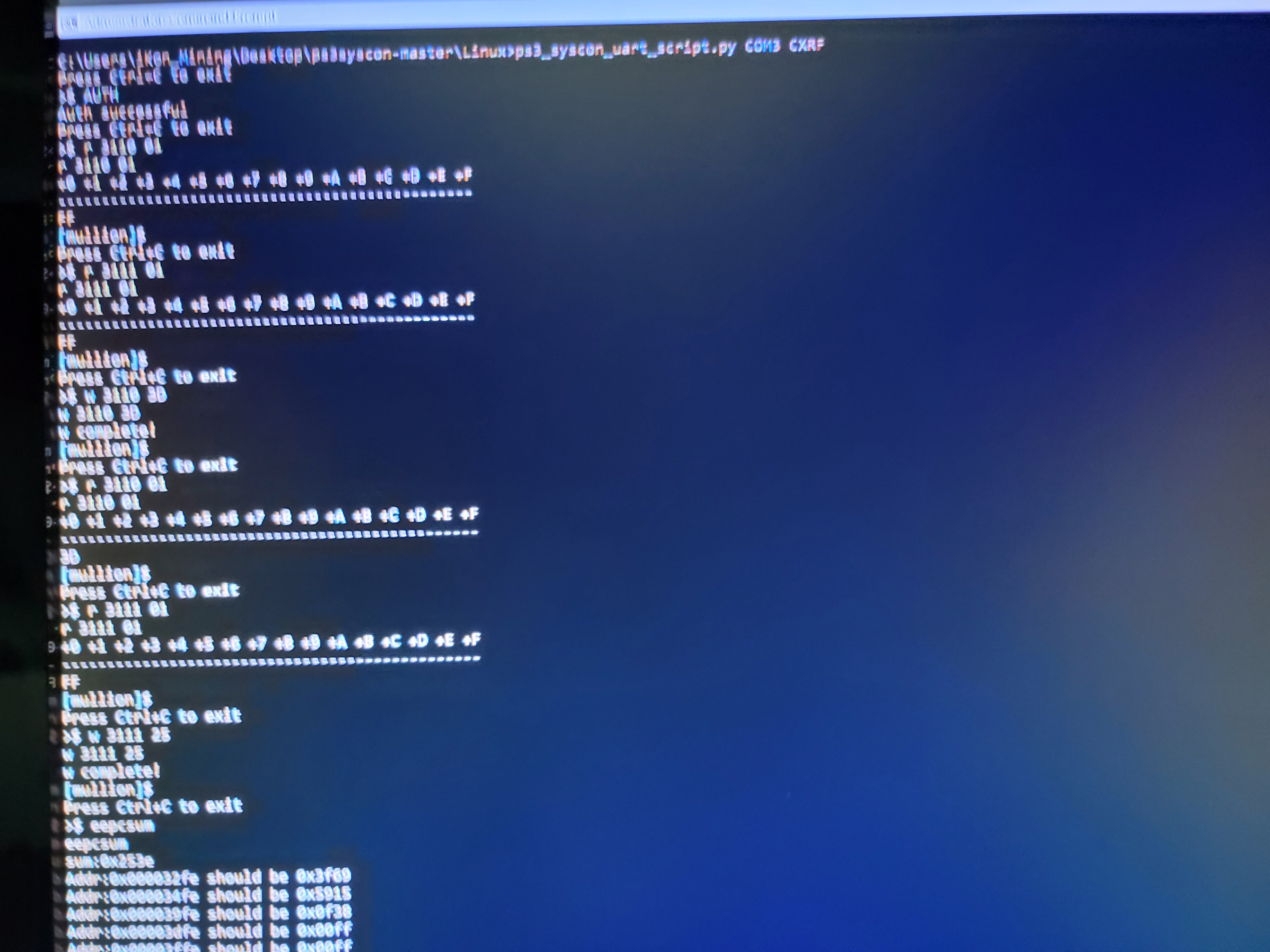
Instead of physically replacing the RSX VDDR regulator components used in the required Frankenstein voltage conversion, our undervolting service changes the appropriate processor VID configuration through the PS3's SYSCON.
The selected VID value instructs the core-voltage regulator to use a different VDDC setpoint.
This allows the processor-core voltage to be optimized while retaining the regulator's normal control architecture and protection functions.
RSX undervolting changes RSX_VDDC / Vcore.
It does not replace the required VDDR conversion and it does not automatically change the other RSX power domains.
The following rails should not be confused:
Changing one rail does not mean we have automatically lowered every voltage entering the RSX.
Processor power consumption is strongly influenced by operating voltage. When a particular CELL or RSX can perform its workload reliably at a lower VDDC setpoint, reducing that unnecessary voltage lowers electrical power and therefore reduces the heat generated by the processor.
This attacks heat at its source.
A larger fan can remove more heat after the processor generates it. Better thermal material can transfer that heat more efficiently. Undervolting is different because it can reduce the amount of heat being produced in the first place.
We do not treat undervolting as a universal fixed-voltage modification.
Two processors of the same model and manufacturing generation can have different stable voltage requirements due to normal semiconductor variation, age and operating condition.
The objective is therefore not the lowest number we can make appear on a meter.
The objective is the lowest practical core voltage that maintains reliable operation under sustained real-world load.
An excessive undervolt can produce instability rather than efficiency.
Depending on which processor has insufficient voltage, symptoms can include:
For this reason, a successful XMB boot is not enough to approve an undervolt.
The completed system must be exercised under sustained CPU and GPU workloads to determine whether the selected VDDC configuration has adequate operating margin.
This is not a game setting, fan-control setting, jailbreak feature or temporary software profile.
The processor VID configuration is stored at the system-controller level and controls the hardware core-voltage request used by the regulator.
The specific SYSCON implementation varies by PS3 hardware generation, which is why the correct VID table and configuration method must be selected for the motherboard being serviced.
A 40nm RSX already operates at substantially lower power than the original 90nm processor, but that does not mean every individual chip requires exactly the same VDDC operating margin.
Once the required Frankenstein VDDR and control modifications are complete, further VDDC optimization can reduce RSX core power even more when the individual processor remains stable.
That reduction works particularly well as part of a Premium thermal build because less RSX power means less heat has to cross the die-level thermal interface, IHS, heatsink and cooling airflow path.
The RSX is only one of the major heat sources inside a backwards-compatible FAT PlayStation 3.
The CELL processor is also a large high-current device and can respond extremely well to carefully selected core-voltage optimization.
Optimizing both processors gives us the opportunity to reduce the total motherboard power demand instead of focusing exclusively on GPU temperature.
We require CELL/RSX undervolting whenever we install an APS-231 in one of our backwards-compatible Frankenstein builds.
The APS-231 has substantially less 12V output capacity than the APS-226. We therefore do not treat it as a simple drop-in PSU upgrade for an otherwise high-power early FAT PS3.
Our APS-231 configuration is built around reducing total system electrical demand first and then selecting the lower-capacity supply for the optimized system.
That means CELL and RSX VDDC optimization is part of the APS-231 package rather than an optional recommendation.
A Premium build can legitimately contain both modifications:
This order makes the distinction extremely clear: first we make the conversion correct; then we optimize it.
Undervolting works best when combined with the other improvements that reduce or better manage system heat:
Voltage modification and undervolting are not interchangeable terms.
The required Frankenstein VDDR and resistor modifications make the replacement RSX electrically compatible with the early FAT motherboard.
Our optional CELL/RSX undervolting service then adjusts VDDC - the actual processor core voltage - to reduce power consumption and heat while maintaining tested system stability.
VDDR conversion makes the Frankenstein correct. VDDC undervolting makes the finished Frankenstein more efficient.
Premium Packages Customized to your budget.
Related Service Options
Most premium restorations combine multiple hardware services depending
on the condition of the console.